
Running a Sex Offender Check in Hillsborough County
The Florida Sexual Offenders and Predators Registry is the official public source for a Hillsborough County registry search. FDLE maintains the statewide system from information supplied by registrants and partner agencies. It is free and needs no account. Search by a name when the person is known, choose Hillsborough County for a broader list, or use the neighborhood tool for a place-based check. The registry itself warns that FDLE does not independently confirm every fact as it arrives, so the source and date shown for an address matter.
Begin with more than one identifier. A full or partial name may bring back several people. Compare date of birth, physical description, designation, address status, and the jurisdiction tied to the listed case. A Hillsborough County result is a registration record, not a complete account of arrests or court outcomes. The underlying local conviction can be checked in Hillsborough County criminal court cases when the profile points to this county.
Map Hillsborough Registry Addresses
FDLE's Neighborhood Search answers a different question from a name search. Enter an address, city, and ZIP code, then select a radius from one-quarter mile through five miles. This can support a focused Hillsborough County safety review near a home, school route, park, or other place used by a family. Results still need close reading because permanent, temporary, and transient addresses can carry different source dates and labels.
The official FDLE registry home shows both name and neighborhood routes.
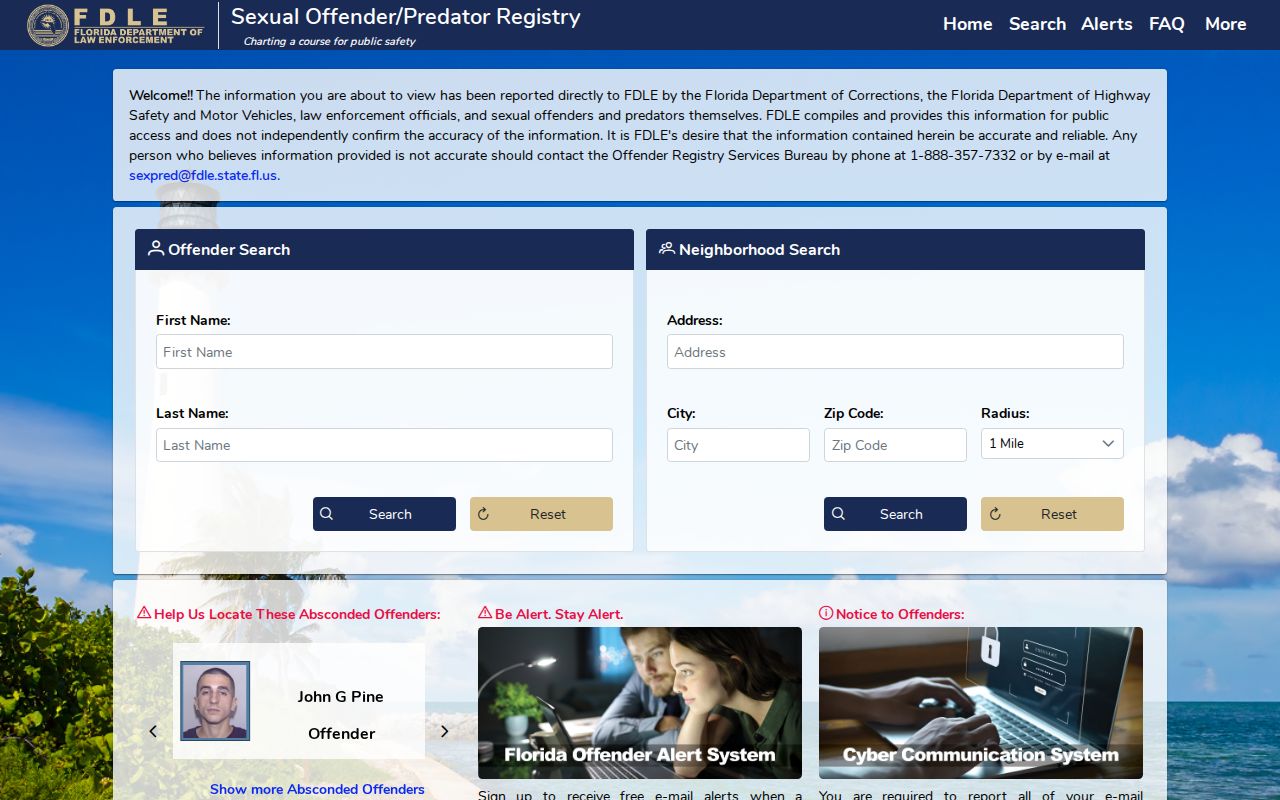
The paired search choices let Hillsborough County users move from a broad map to the individual profile that supplies status and source details.
Searching the Florida Sexual Offenders and Predators Registry
The detailed FDLE interface can search Hillsborough County by person or geography. At least one name or geographic field is needed. Filters then narrow the list by statutory type, status, and whether aliases or thumbnails appear. Results can be reviewed as a list, selected for flyers, or downloaded through county and state CSV functions. PDF printing is limited to 25 selected records, which makes the county CSV more useful for a large result set.
- Open the official detailed search and review its identity and lawful-use warnings.
- Enter a first or last name, or choose Hillsborough County, a city, or a ZIP code.
- Apply offender type and status filters, then compare the result list by more than a name or image.
- Open the full profile and read the address source, designation, case jurisdiction, and current status.
| Field Label | Type | Required | Notes |
|---|---|---|---|
| First / Last Name | Text | Conditional | Full or partial; one name or geographic field is required |
| City / ZIP | Text | Conditional | Builds an area list without a name |
| County | Dropdown | Conditional | Select Hillsborough for county results |
| Offender Type | Dropdown | No | Both, Sexual Offender, or Sexual Predator |
| Status | Checkboxes | No | Includes absconded, confined, deceased, deported, released, and supervision choices |
| Images / Aliases | Checkboxes | No | Add thumbnails or known aliases |
The detailed FDLE search exposes these filters and result controls.
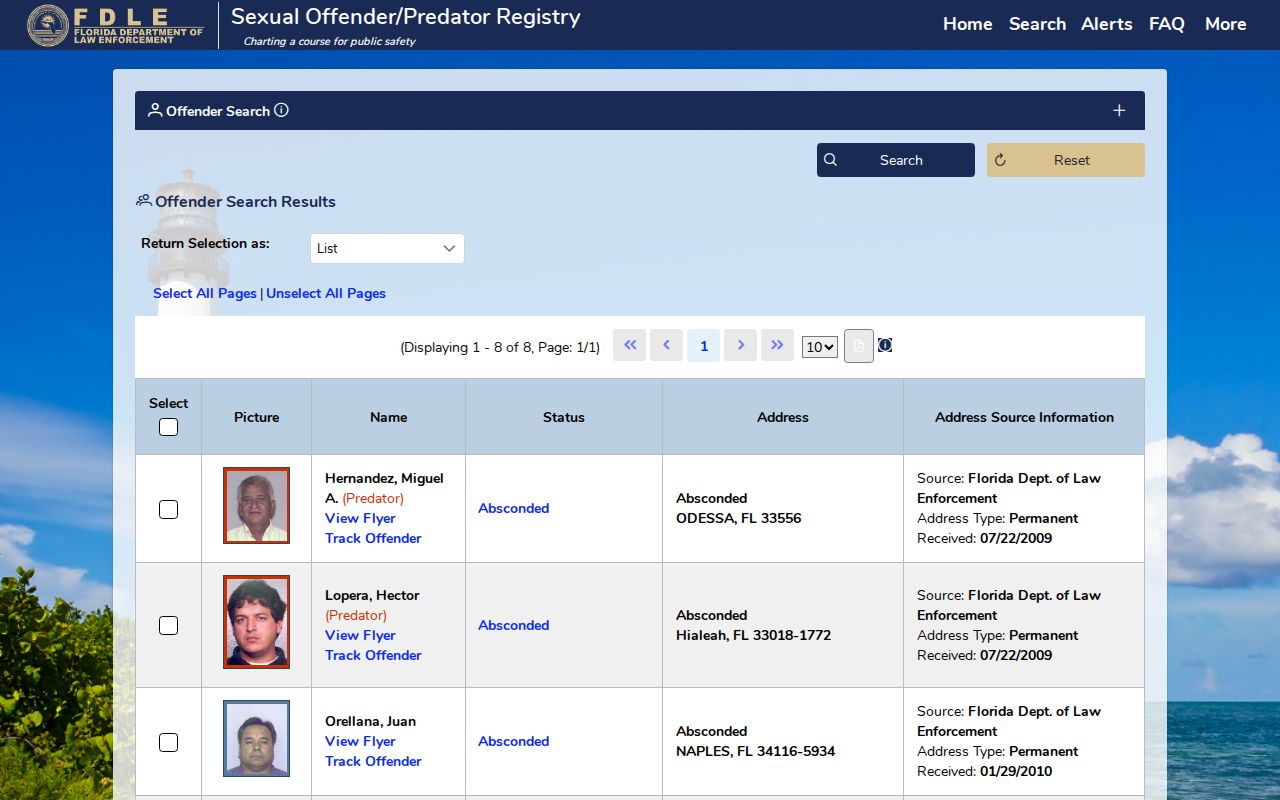
These filters help reduce false matches, but no demographic search replaces fingerprint identification.
Hillsborough Offender Address Alerts
The free Florida Offender Alert System can track movement near a Hillsborough County address or follow a named person. Address alerts use the same one-quarter-mile through five-mile range offered by the neighborhood search. This is more useful than saving a one-time result because registry addresses may change. An alert is a prompt to reopen the official profile, not proof that the person committed a new offense or violated a duty.
For records outside Florida, the National Sex Offender Public Website searches participating jurisdictions. NSOPW is the cross-state layer; FDLE remains the better source for Florida profile detail, Hillsborough County status labels, flyers, and local reporting contacts.
What a Registry Profile Shows
An FDLE profile combines identity, address, adjudication, and status fields. Historical photos and aliases can help distinguish people with similar names. Address entries may be permanent, temporary, or transient and show a source, type, and date. Case fields can name the crime, statute, adjudication date, case number, jurisdiction, and result. Victim information is categorical, such as age group and gender, never a victim's name. Vehicle details may include year, color, make, model, body, and tag.
| Name & Aliases | Legal name and known alternate names |
|---|---|
| Photo & Description | Current and past photos, birth data, sex, race, build, hair, eyes, scars, marks, and tattoos |
| Registered Address | Permanent, temporary, or transient place with source, date, type, and map |
| Offense & Statute | Adjudication date, crime, law, case number, jurisdiction, and result |
| Designation | Florida Sexual Offender or Sexual Predator, not a federal-style risk tier |
| Registration Status | Release, confinement, absconded, supervision, or other published state status |
The official registry FAQ explains profile data and correction routes.
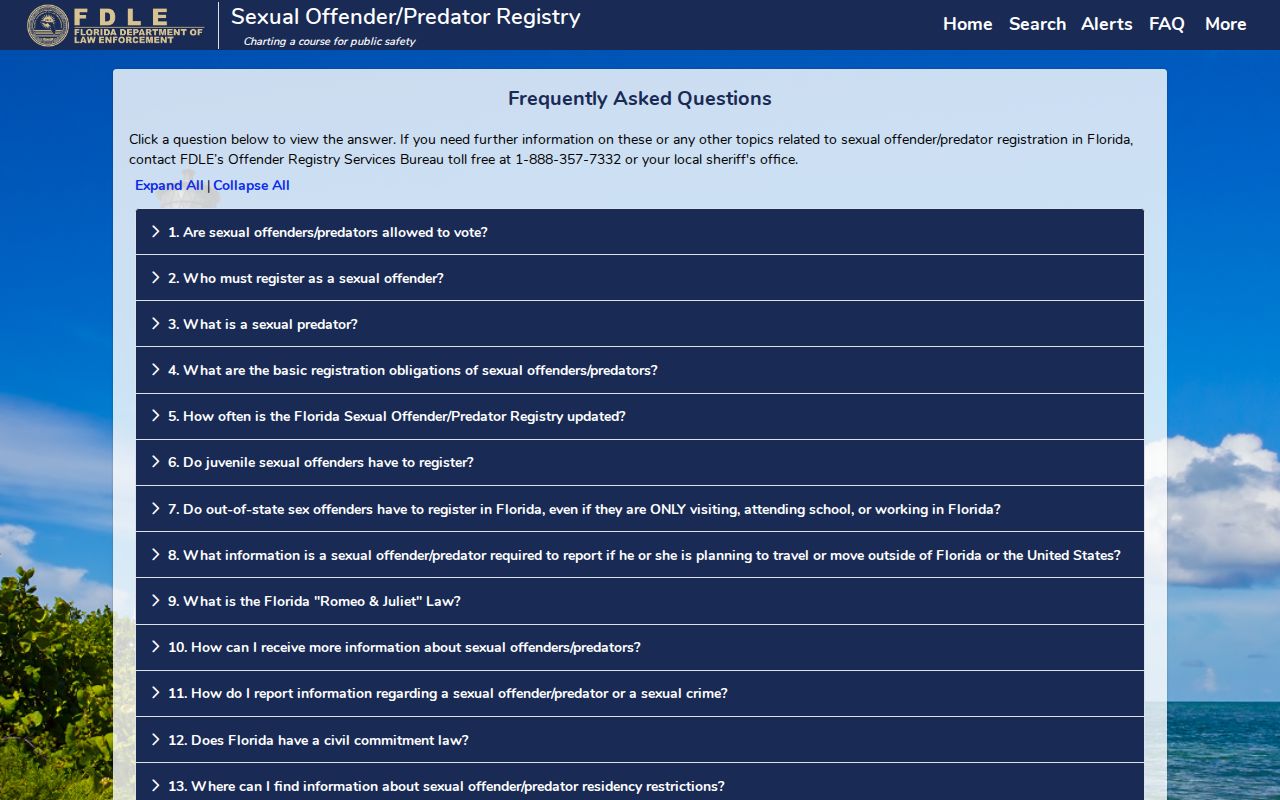
The guidance makes clear that collected statutory data can be broader than the fields shown on a public flyer.
Hillsborough Offender Registration Unit
HCSO receives local in-person reports at the Offender Registration Unit in the Re-Entry Center, 1201 Orient Road, Tampa, FL 33619. The direct line is 813-247-8460. The official directory does not publish set hours, an appointment rule, or a fee, so call before visiting. Florida generally requires an initial sheriff report within 48 hours after a person establishes a covered residence or status. The exact duty depends on the statute and the person's designation.
HCSO Offender Registration Unit
Re-Entry Center
1201 Orient Road
Tampa, FL 33619
813-247-8460
Call first for current intake instructions.
Suspected stale or noncompliant Hillsborough County data should go to HCSO or FDLE. Do not visit a listed address or confront a person. Registry corrections can also be reported to FDLE at 1-888-357-7332 or sexpred@fdle.state.fl.us.
Registration Requirements and Levels in Florida
Florida does not publish Tier I, II, and III risk levels. Its legal labels are Sexual Offender and Sexual Predator, with some people subject to quarterly reporting based on a separate statutory category. The baseline duration is generally life. A narrow petition route may exist for an ordinary adult offender after at least 25 sanction-free years with no intervening arrest, but exclusions apply. A qualifying juvenile registrant may seek the limited relief described in section 943.04354. A Hillsborough County registry result should be read by its actual designation and status, not forced into another state's tier model.
| Level / Tier | Duration | Verification Frequency |
|---|---|---|
| Sexual predator | Generally lifetime | Quarterly |
| Ordinary adult offender | Lifetime baseline; narrow petition after at least 25 qualifying years | Twice yearly |
| Specified quarterly offender | Same lifetime framework | Quarterly |
| Qualifying juvenile registrant | Lifetime framework; narrow statutory relief may apply | Quarterly |
Hillsborough Registry Residence Rules
Florida section 775.215 creates a conditional 1,000-foot residence rule for specified offenses and victim ages. It is not a universal distance rule for every person in the Hillsborough County registry. The offense, date, victim-age category, and statutory exceptions matter. A public map can show distance, but it cannot decide whether the restriction applies to that person or address.
Predator notification has a separate function. Florida requires notice to licensed child-care facilities and K-12 schools within one mile when a sexual predator moves into the covered area. Notification for a person designated only as an offender is authorized but is not universally mandatory in the same way. Those distinctions are why the profile's exact Florida designation matters.
Correct a Hillsborough Registry Address
An address that looks old should be checked against its source date and status before it is reported. Review aliases, historical addresses, release status, and the case jurisdiction. Then save the profile link and note the precise field that appears wrong. Send suspected Hillsborough County noncompliance to local law enforcement or FDLE, using the registry contact line or email. Do not publish a revised address yourself.
FDLE continuously updates information supplied by partner agencies and registrants, yet it does not independently verify each item. A report can prompt the responsible agency to check the source record. That process protects both neighborhood awareness and the integrity of the registry.
Lawful Use and Community Notification
The registry supports awareness and practical safety planning. It does not authorize threats, coercion, false publication, or alteration of official data. Use the official alert tools, discuss age-appropriate safety steps, and report a suspected breach through law enforcement. Never treat a list result as permission to confront a person or household.
Use registry data lawfully: Florida Statutes section 775.21(10)(d) makes certain payment coercion, knowingly false publication, or material alteration or misrepresentation of registry information a first-degree misdemeanor.