
How to Check Criminal History in Temple Terrace
Choose the source by the fact you need. Temple Terrace Police can release a city police report under Florida public-records law. HCSO shows county jail intake and release facts. HOVER supplies the filed criminal case and outcome, while FDLE searches Florida repository data. A report or booking is not a conviction record.
- Contact the Temple Terrace Police Records Unit for a report created by city officers. Give a report number, date, location, and record type if known.
- Ask what can be released, whether redactions are needed, and what the estimated copy cost will be.
- Search HCSO Arrest Inquiry if the city event led to county booking.
- Search HOVER for the filed Hillsborough criminal case and disposition.
- Use the FDLE Florida Criminal History Record Check for statewide name-based scope or Personal Review for one's own fingerprint-linked record.
Verify identity with dates and public identifiers. Temple Terrace report numbers, HCSO booking numbers, and Hillsborough case numbers are not interchangeable. A gap at one stage may simply mean no record was created there.
Temple Terrace Police Records Unit
The Records Unit is on the third floor of City Hall at 11250 N. 56th Street, Temple Terrace, FL 33617. It can be reached at 813-506-6516 from 8 a.m. to 4 p.m., Monday through Friday. The official page also provides an email channel. Call before visiting when the request may involve an active case, a large file, or a record with protected details.
Police Records Unit
Third Floor, City Hall
11250 N. 56th Street
Temple Terrace, FL 33617
813-506-6516
Monday through Friday
8 a.m. to 4 p.m.
The unit processes TTPD reports under chapter 119. No downloadable request form, fixed identity rule, detailed payment method, or guaranteed turnaround was found in the source. A short call can prevent an avoidable trip and lets staff explain the current request method.
The Temple Terrace Police Department
The Temple Terrace Police Department keeps reports made by its officers. Those files may include incident facts and an investigative narrative that will not appear in a booking summary or court docket. If HCSO or another agency created the report, the request must go to that agency instead.
The official police page provides a view of the city department and its services. The following image comes from the Temple Terrace Police page.
The city source helps a requester confirm that TTPD is the right custodian. It does not turn the Police page into an arrest log or court search. Ask Records for the report, then use county systems for booking and prosecution.
Temple Terrace Criminal Record Copy Fee
Temple Terrace publishes a specific police-record copy charge: 15 cents for a one-sided page. That fee belongs to the city Records Unit. It should not be assumed to apply to HCSO, the Hillsborough Clerk, or another police department. Larger, complex, or specially processed requests may involve rules beyond a simple page copy, so obtain an estimate first.
| Record service | Published amount | Confirm before ordering |
|---|---|---|
| One-sided police-record page | $0.15 per page | Page count, available format, redactions, and delivery method |
| Other or extensive work | Not stated in the city profile | Ask the Records Unit for a written estimate |
A low per-page price does not guarantee immediate release. Staff may need to locate the file, review it for exemptions, and redact protected material. Narrow date and location details help the search.
Note: The 15-cent fee is a Temple Terrace police copy charge, not a county-wide criminal records price.
Arrests and Bookings in Temple Terrace
When Temple Terrace Police makes an arrest, county booking data is created through HCSO. TTPD remains the source for its police narrative. HCSO holds intake fields such as arresting agency, booking time, initial charges, bond or holds, custody status, and release information. The two records can update at different times.
Booking information describes the circumstances known at arrest. It does not establish guilt, innocence, acquittal, dismissal, or a final outcome. The State Attorney can file different charges after review. Search HOVER for the court result and read each count separately. The county arrest history page explains the booking window and older-record fallback in more depth.
Do not merge stages: A Temple Terrace police report, an HCSO booking, and a HOVER case are distinct public records.
Temple Terrace Arrest Search Fallback
No official city arrest blotter or self-service TTPD report search was documented. The fallback is direct and reliable: ask the Records Unit for the police file, use HCSO Arrest Inquiry for booking, and use HOVER for the filed case. If the online booking window no longer contains the event, send an HCSO public-records request.
The Sheriff's official request route is illustrated below. The image comes from the HCSO Public Records page.
The county request route is useful for HCSO-created booking and sheriff records. It should not be used to ask HCSO for a TTPD incident narrative that the city department created.
Temple Terrace Municipal Court Records
Temple Terrace City Hall is not a municipal criminal court. Florida abolished traditional municipal courts. A TTPD arrest ordinarily moves into Hillsborough County Court for a misdemeanor or the Thirteenth Judicial Circuit Court for a felony. Search HOVER or contact the Hillsborough Clerk rather than asking City Hall for a criminal docket.
| Court Name | Hillsborough County Court for misdemeanors; Thirteenth Judicial Circuit Court for felonies |
|---|---|
| Case Types Heard | Filed misdemeanor and felony prosecutions and assigned county ordinance criminal matters |
| Case Lookup Channel | HOVER or the Hillsborough Clerk of Court |
| What the Docket Shows | Filed charges, events, pleas, orders, disposition, sentence, and available public images |
| Copies & Fees | Free public noncertified HOVER images when available; current Clerk fees apply to certifications and paper files |
The anchor phrase “Temple Terrace Municipal Court Records” corrects the searcher's premise. TTPD is a city agency, but the criminal prosecution belongs to Hillsborough's county and circuit court system.
Temple Terrace In Touch Limits
The city's “In Touch” app handles municipal service requests and notifications. It is not a police-record request, arrest inquiry, warrant check, or criminal court search. Sending a service ticket through the app does not replace contact with the Police Records Unit.
Use the app for the civic tasks it was made to handle. For a TTPD report, call Records. For an HCSO booking, use the Sheriff's channel. For filed criminal charges and case outcomes, use HOVER. Keeping those tools separate prevents a service request from being mistaken for a records request.
Where Temple Terrace Records End Up
A TTPD incident can produce several records as it moves through the justice system. The city police report remains with Temple Terrace. An HCSO booking appears if a person enters county detention. The State Attorney reviews possible charges, and the Clerk maintains the resulting docket in HOVER. Fingerprints and later disposition reporting may add the arrest cycle to FDLE.
Record flow: Temple Terrace Police › HCSO booking › Hillsborough County Courts and HOVER › Florida Department of Law Enforcement
Each stage has its own date and number. An incident time, booking time, filing date, and disposition date need not match. A recent city event is best checked through TTPD and HCSO; the final legal outcome belongs in the court file.
Temple Terrace FDLE Registry Route
TTPD links residents to the Florida Sexual Offenders and Predators Registry. That official registry supports name and neighborhood searches, but a registry listing is not the person's complete criminal history. It answers registration-status and public-safety questions under Florida law.
The city public-record route is shown in the next image, sourced from the Temple Terrace Public Records page.
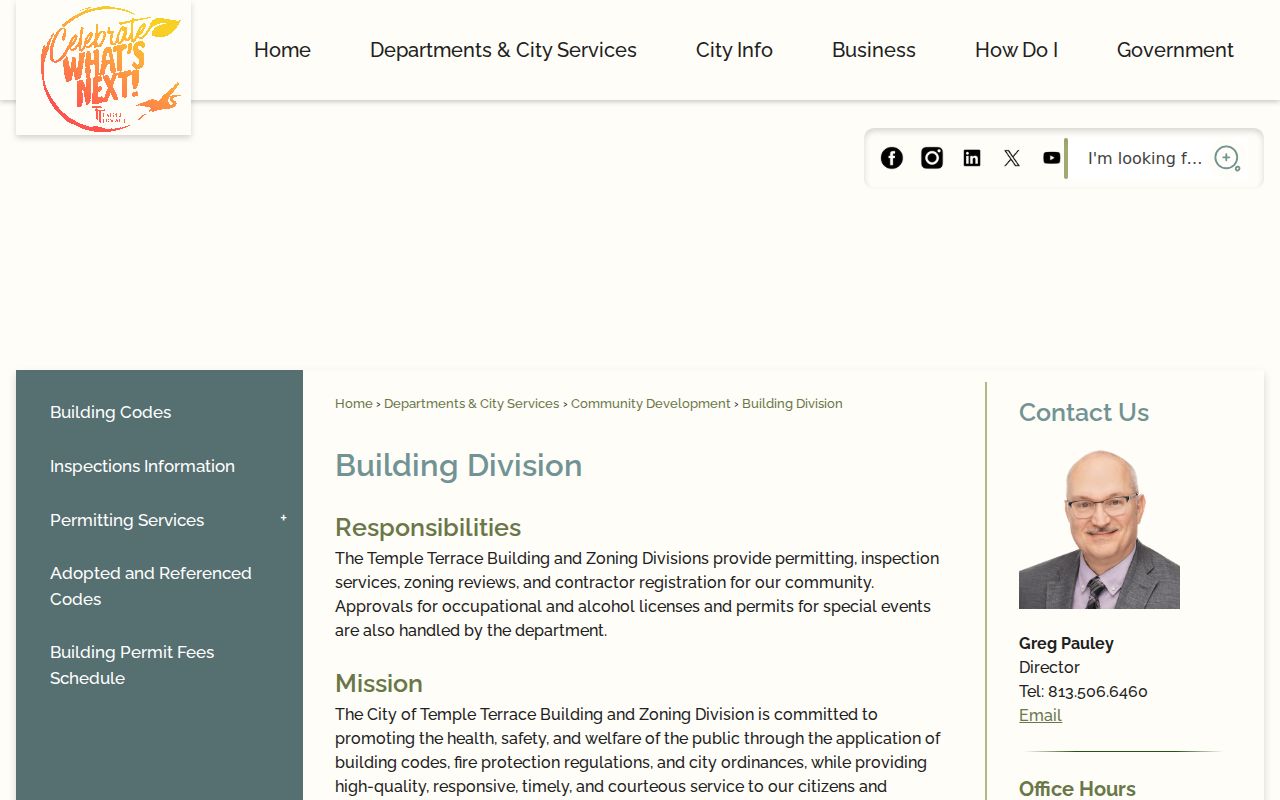
Use that city route for records held by Temple Terrace. Use FDLE's registry for registration data and HOVER for the underlying Hillsborough conviction file. Do not assume one source replaces the others.
Temple Terrace Record Boundary Check
Temple Terrace covers a compact 7.39 square miles near the Hillsborough River, Riverhills Drive, Florida College, and the USF area. A Temple Terrace mailing address does not by itself prove that TTPD handled an event. Verify the city boundary with official GIS when the location sits near an edge.
Jurisdiction determines the report custodian. If the event was outside city limits, HCSO or another agency may hold the police narrative. The county booking and court channels may still show later stages even when TTPD has no report. Agency name on the booking entry or case paperwork can help resolve the route.
Temple Terrace Criminal Record Context
Temple Terrace incorporated in 1925. Its name joins the Temple orange with terraced land along the Hillsborough River. The planned community grew around a golf course and a grove once measured at about 5,000 acres. City services and an early code followed in 1926, with the first officer serving by the late 1920s.
That history gives older civic records a different context from current police files. The citywide Multimodal Transportation District and major local corridors can shape modern calls for service, but a call or traffic contact is not proof of an offense, arrest, or conviction. Use the official record from the agency and court before drawing a conclusion.
Public Access Rules for Temple Terrace Records
Temple Terrace processes police reports under Florida Public Records Law. The right of access covers nonexempt material, not every fact in an active investigation. Protected victim information, juvenile material, exempt identifiers, and active investigative details can be withheld or redacted. Court records and FDLE repository records follow their own access rules.
Key Statutes:
Florida Statutes section 119.07 requires prompt good-faith access to nonexempt records and allows lawful redaction and charges.
Florida Statutes section 943.053 controls FDLE dissemination of criminal justice information.
Florida Rule 2.420 governs access and confidentiality in judicial records.
If the city asserts an exemption, ask for the statutory basis and the nonexempt remainder. A search with no result does not certify that no record exists. Confirm with the office that created the record.